
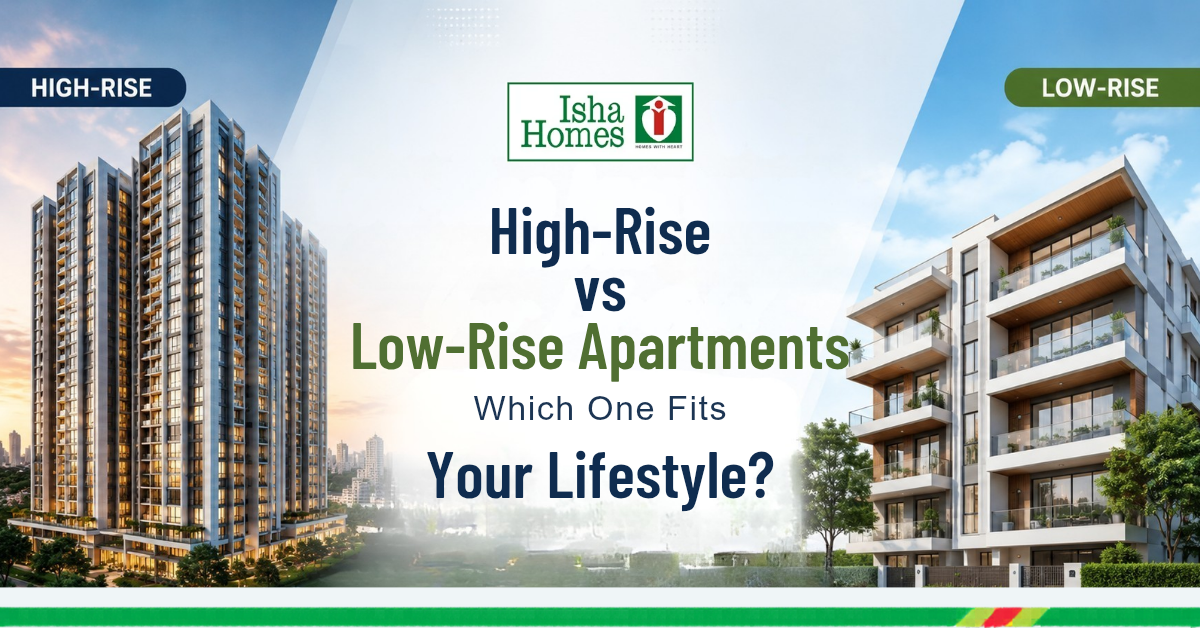
High-Rise vs. Low-Rise Apartments: Which One Fits Your Lifestyle?
Confused between high-rise and low-rise apartments? Compare floors, cost, privacy, safety and lifestyle to pick the right home for your needs.
High-Rise vs Low-Rise Apartments
You’ve narrowed your apartment hunt down to a shortlist, and now every second listing asks the same question: high-rise or low-rise? It sounds like a small detail. It isn’t. The height of your building changes your commute to your own front door, your maintenance bill, how much sky you see from your balcony, and how a fire escape plan actually works.
Here’s what separates the two, based on real building codes and lived-in comparisons, not brochure copy.
What Counts as High-Rise or Low-Rise?
A high-rise is generally a building with over 10 floors, though the cutoff shifts by country. In India, some definitions apply the term to buildings with 4 or more storeys, while the U.S. National Fire Protection Association sets the line at 7 stories. For construction and fire code purposes, India’s National Building Code goes by height instead: any building 15 metres or more, measured from average ground level to the top occupied floor, counts as high-rise.
A low-rise apartment usually tops out at 1 to 4 floors, occasionally stretching to, and sits in suburban or less densely populated areas rather than the city centre. Somewhere between the two sits the mid-rise, typically 6 to 9 storeys, offering a balance of privacy and amenities.
Space, Privacy, and Noise
Low-rise buildings have fewer flats packed into one structure, which means fewer neighbours, less foot traffic and lower noise overall. High-rises flip that as you go up: lower floors deal with lift traffic and street sound, but upper floors tend to be quieter, since they sit away from ground-level activity. RentCafe’s comparison puts it plainly: a 30th-floor unit often has more privacy, less noise and cleaner air than a ground-floor unit in a low-rise, while a first-floor high-rise unit gets similar street access, minus the view. So inside a high-rise, the floor you land on matters as much as the building type itself.
Amenities and Facilities
High-rises are usually part of large residential projects, so they come with lifts, basement parking, and shared amenities like clubhouses or swimming pools. Bigger towers add more still, often including indoor and outdoor pools, gyms, and business centers.
Low-rise living trades that for something more private. Many units come with patios, balconies, or shared courtyards, along with dedicated parking that’s usually easier to access than a high-rise garage. If you’d rather step into your own patch of garden than share a rooftop pool with 200 households, low-rise wins here.
Cost: Purchase Price and Upkeep
Low-rise units, especially in suburban or still-developing pockets, tend to be cheaper both at purchase and on the monthly maintenance bill. High-rises run higher costs because of what they maintain: lifts, pools, security staff. On top of that, higher floors often carry their own floor-rise premium, layered onto already-higher maintenance charges. That said, high-rise land sits closer to transit and job hubs, which is part of why high-rise resale values can climb faster in some markets.
Safety and Fire Compliance
This is the part most apartment hunters skip and the one that matters most in an emergency. Under India’s National Building Code, any structure 15 metres or taller is classified as high-rise, pulling it into a stricter compliance bracket. Buildings above that threshold need dedicated fire lifts, pressurised wet riser systems, automatic fire alarms and fire-resistance ratings on structural elements. They also need setback space around the structure so ventilation and emergency vehicles have room to work.
A Fire NOC is mandatory for most residential buildings above the height threshold, typically 15 metres, though a few states set it lower, around 12 metres. Rules keep tightening: a 2025 draft revision to the National Building Code adds addressable fire detection for buildings above 15 metres, replacing older zone-based systems that couldn’t pinpoint exactly where an alarm triggered. Low-rise buildings face a shorter checklist mainly because evacuation is quicker when you’re climbing down two or three flights instead of thirty, not because fire risk disappears.
Accessibility for Families and Elders
Low-rise apartments tend to offer more direct ground access, which helps people with limited mobility move around daily. No waiting on a lift that’s stuck because someone’s shifting furniture. High-rises can work fine here too, but any elevator malfunction directly affects how easily residents get in and out of their own homes, and that inconvenience grows the higher up you live.
Which One Should You Choose?
There’s no single right answer. A young professional who wants a gym downstairs and a five-minute commute will lean high-rise. A family with toddlers, a dog and a preference for knowing their neighbours will usually lean low-rise. Walk both. Check floor-rise charges before signing on a high-rise. Ask for the Fire NOC and maintenance breakdown regardless of which one you pick. The building type sets the frame, but the specific project, floor and management are what you’ll actually live with.
Frequently Asked Questions?
- Is it better to live on a high floor or a low floor in a high-rise?
Higher floors generally mean better views, more light, less street noise and fewer insects. Lower floors mean faster access, no dependency on a working lift, and lower cooling costs. With young kids or elderly parents at home, a lower or mid-level floor is usually more practical.
- Are high-rise apartments safer than low-rise ones?
Not automatically. Safety comes down to construction quality, maintenance and fire compliance, not height alone. High-rises above 15 metres in India fall under stricter National Building Code rules, including fire lifts and a mandatory Fire NOC. A poorly maintained high-rise can still be riskier than a well-run low-rise, so check the fire safety certificate before signing, regardless of height.
- Do high-rise apartments cost more to maintain than low-rise ones?
Usually. High-rises run lifts, pools, generators and larger security teams, all reflected in the monthly bill, and many charge a floor-rise premium on top. Low-rise buildings have simpler shared infrastructure, so maintenance tends to run lower, though a low-rise with an elaborate clubhouse can still cost more than a stripped-down high-rise.
- Is a low-rise apartment a good option for a family with young children?
Often, yes. Ground-level access means no waiting on lifts with a stroller, easier supervision when kids play outside, and typically less traffic through the building. Some high-rises do offer dedicated kids’ play areas and stronger entrance security, so it’s worth comparing specific projects rather than ruling out high-rises entirely.